
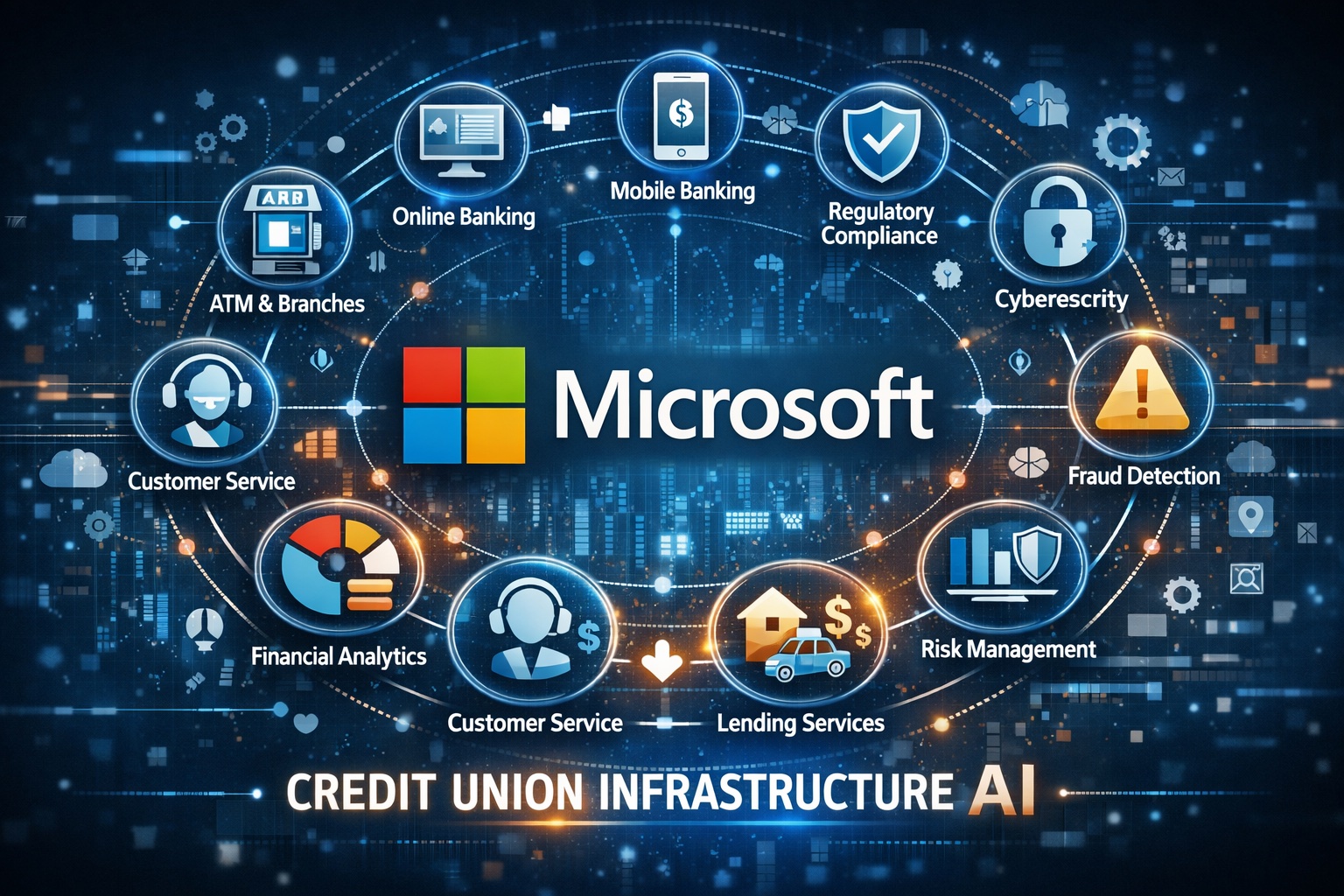
Microsoft’s recent launch of Optimind marks an important inflection point in enterprise AI. While much of the attention around AI has focused on new models, copilots, and productivity tools, Optimind points to a more consequential shift: organizations now need a way to manage AI at scale, not just deploy it.
For credit unions, this matters more than it may initially appear.
Over the past 18 months, many credit unions have quietly embedded AI into everyday operations. Fraud teams rely on machine learning models from vendors. Contact centers use AI-assisted scripting and summaries. Marketing teams deploy predictive targeting. Lending platforms increasingly incorporate automated decision support. None of this is new.
What is new is the growing realization that these tools are fragmented, inconsistently governed, and increasingly difficult to explain to regulators, boards, and even internal stakeholders.
Optimind is designed to sit above individual AI tools and workflows, acting as an orchestration and optimization layer. Rather than introducing yet another AI feature, Microsoft is addressing the harder problem: how enterprises control, monitor, and improve AI systems once they are already embedded across the organization.
That framing aligns closely with where credit unions are today.
Most credit unions are no longer asking whether they will use AI. They are asking how to manage it responsibly.
From a governance perspective, Optimind reflects the direction examiners are already heading. Regulators are less concerned with whether an institution uses AI and more concerned with how decisions are made, documented, monitored, and corrected over time. An orchestration layer that provides visibility into AI behavior, data usage, and performance drift directly supports model risk management, third-party oversight, and audit readiness.
Operationally, the launch signals a move away from one-off pilots. Credit unions often struggle to move successful AI use cases beyond a single department because each implementation relies on custom integrations, manual oversight, or vendor-specific tooling. Optimind’s approach suggests a future where AI agents and workflows can be reused, governed centrally, and continuously optimized across lending, fraud, member service, and back-office operations.
There is also a strategic implication for vendor relationships. As orchestration layers mature, AI differentiation may shift away from surface-level features and toward how well vendors integrate into a governed AI ecosystem. Credit unions may increasingly evaluate core, digital banking, and fintech partners not just on AI capabilities, but on how those capabilities fit into enterprise-level AI controls.
Perhaps most importantly, Optimind highlights a reality credit union leaders are beginning to confront: AI risk is no longer theoretical. Once AI influences member outcomes, pricing, approvals, or fraud decisions, institutions need confidence that systems behave as intended over time. That requires tooling designed for monitoring and accountability, not just speed and automation.
The launch of Optimind does not mean credit unions need to adopt another Microsoft product immediately. What it does mean is that the market has moved. AI governance, orchestration, and optimization are now first-order concerns, not future considerations.
For credit unions still treating AI as a collection of disconnected tools, Microsoft’s move is a clear signal. The next phase of AI adoption will be defined less by what AI can do and more by how well institutions can control it.