
A Hardship-Treatment Record for AI-Assisted Credit Union Collections
Connect member circumstances, approved policy, human judgment, communications and outcomes to one reviewable treatment record.

CreditUnionAI News
AI, core technology, payments, and regulation for credit union leaders, fintechs, and service providers.
Watch CUAI Weekly
The week’s consequential credit-union developments—and why they matter—in under four minutes.
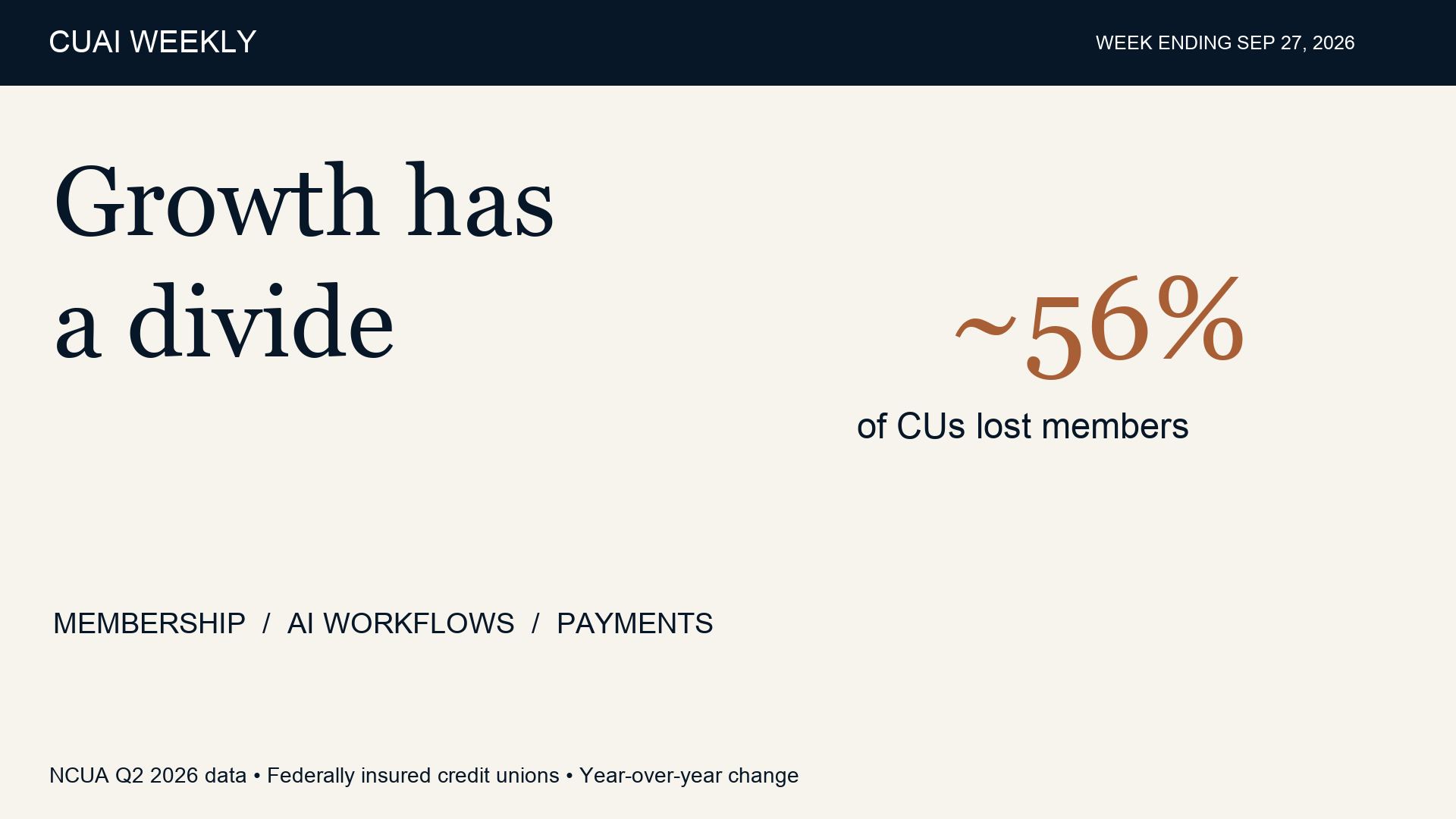
Week ending September 27, 2026 · 3 min 12 sec
New NCUA figures reveal uneven membership growth. Plus: AI workflow tools and a planned payments network.
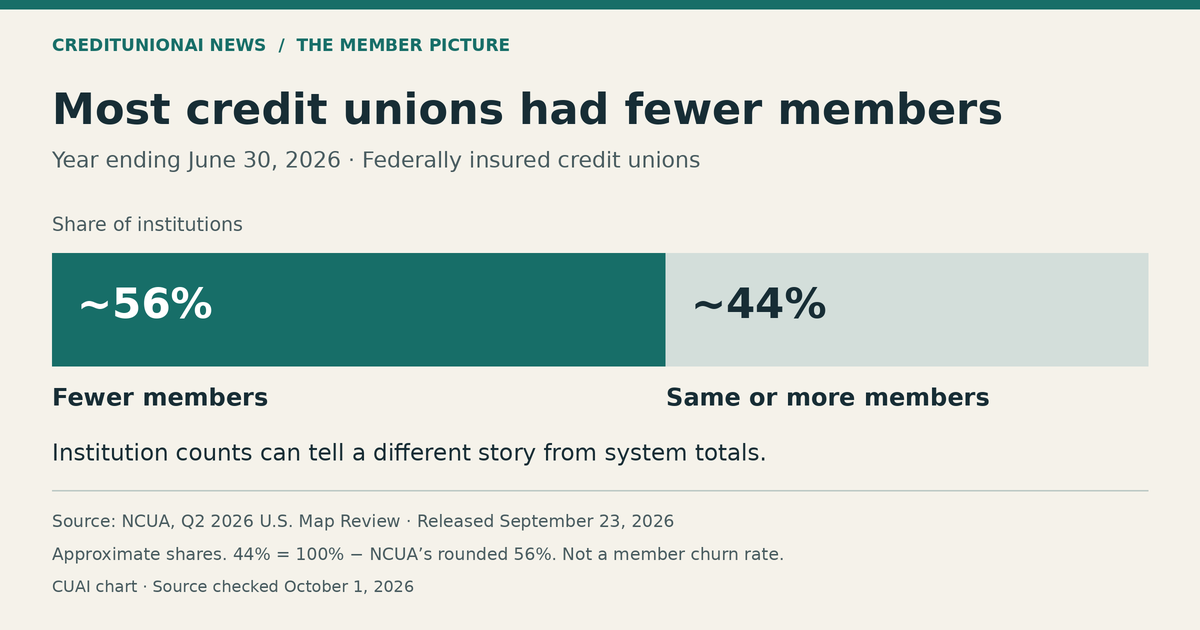
Data chart · October 6, 2026
System membership still grew. See the institution-level split and a membership bridge for reviewing your own results.
Read the chart and methodLatest AI Newsroom Alert
Timely reporting and practical guidance for credit-union decisions.
Connect member circumstances, approved policy, human judgment, communications and outcomes to one reviewable treatment record.

The credit-score provider is flattening its structure and changing product development as mortgage-score competition increases.

The new model reads the order and cadence of account transactions, giving lenders more context—and a fresh validation obligation.

Connect product value, member outcomes, complaints, economics, risk and exit readiness to a reviewable keep, change or retire decision.

The lawsuit tests whether digital-asset firms can use national trust charters for custody and payments without the framework applied to insured depositories.

The proposal shifts accountability toward target-market activity and could change eligible market categories and evidence requirements.

The order preserves category-specific consent and makes urgent financial-institution fraud alerts easier to deliver.

The controlled Ethereum pilot puts reserve, redemption, access and reconciliation controls into a live institutional test.

Use AI to organize management information while preserving sources, uncertainty, management accountability and board judgment.

Credit unions that issued Apple Pay-enabled cards and paid transaction fees now fall within a certified class, subject to later case decisions.

Extract obligations and organize evidence without letting a model interpret the contract or decide whether to renew.

Compare sources and draft redlines without letting a model decide what applies or publish policy changes.

Organize complaint evidence without letting a model decide whether harm occurred or what remediation a member receives.

The launch moves more than $25 billion in annualized card volume onto infrastructure that payments teams must govern for liquidity, reconciliation and failover.

Forecast demand without turning a model into the authority for staffing, hours or member access.

A data-center cooling failure disrupted core and digital services and shows why redundant hosting must cross real failure domains.

Keep risk limits, deposit-pricing authority and contingency funding outside the model while AI improves forecasts.

Keep policy outside the model, route exceptions through governed authority and monitor the full borrower-outcome funnel.

Use five evidence lanes, hard-stop conditions and time-boxed holds to decide which AI initiatives to scale, fix or retire.

AI is making convincing scams cheaper to scale. Credit unions need one clock for verification, payment intervention and recovery.

The financial-sector cyber group says exposed-system fixes should move to hours or days as AI accelerates vulnerability discovery and exploitation.

Credit unions can use the alternative score now, but the model choice must remain consistent through underwriting, pricing and delivery.

Qualifying digital credentials may support customer identification, but the existing reasonable-belief and fraud tests remain.

The migration simplifies delivery; the operating test is incremental lift, member value and reliable offer-suppression controls.

A six-lane scorecard that keeps coaching evidence separate from pay, discipline and promotion decisions.

The selection moves AI into third-party reviews; the operating test is traceable evidence, human approval and measurable quality.
CreditUnionAI Weekly Briefing
Watch the latest published CUAI Weekly and follow its sources. Browse coverage for your team, institution, or credit-union clients.