
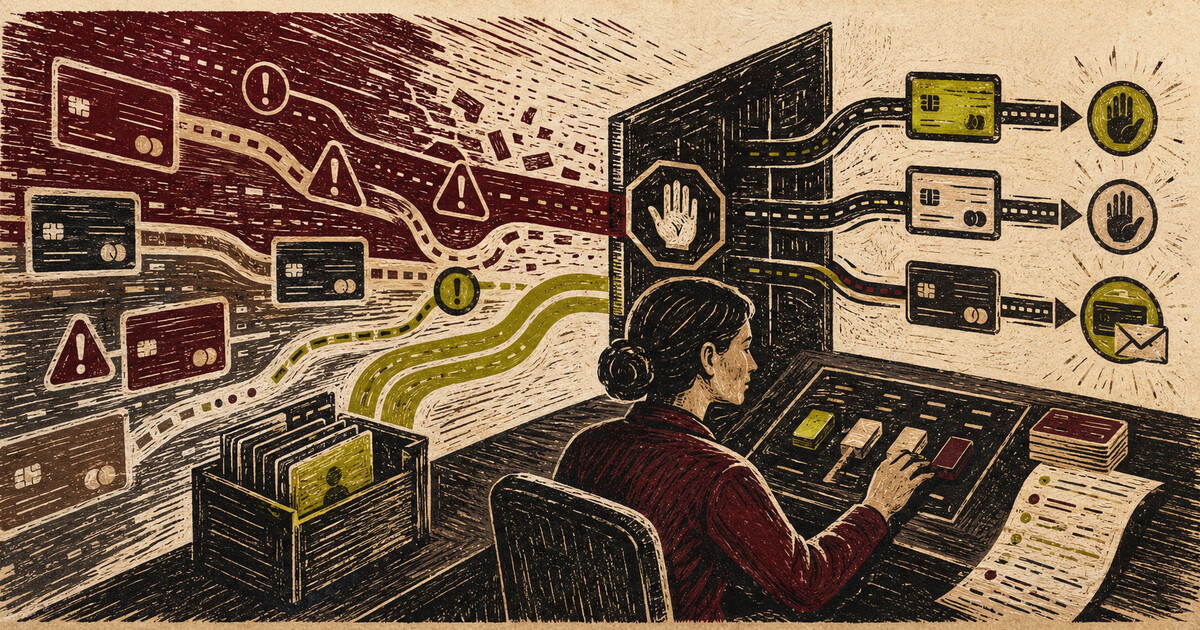
Velera has launched a fraud-response system that it says gives credit unions near-real-time control over suspicious card activity, moving the operating question from how quickly a model can detect risk to how quickly staff can act on it.
Velera announced Risk Alert Manager on July 28, and Credit Union Times independently reported the launch on July 29. According to the CUSO, the product combines fraud alerts, cardholder-interaction data and response tools in a single application powered by its Atmos Risk platform.
The listed controls include blocking or unblocking a card, placing it under monitoring, initiating a reissue and adding an account memo. Velera also says the system provides an audit history, dashboards and reporting, works with Mastercard and Visa cards, and can offer premium alerts. Those are vendor claims. Velera disclosed a pilot with unnamed credit unions, but it did not publish the number or size of participants, measured response-time improvements, fraud-loss reductions, false-positive rates or member outcomes.
The change is in the response workflow
Credit unions already receive fraud signals from processors, card networks and internal systems. The friction often begins after a signal appears: an alert may create a ticket, move between teams and require a separate system to change card status or record the decision. Risk Alert Manager is designed to compress those handoffs by putting detection context and card actions in the same operating environment.
That distinction matters. A more accurate model can still underperform if a queue is understaffed, escalation rules are unclear or an employee must wait on a third party to execute a block. Conversely, faster action can create new harm if the system makes it too easy to restrict a legitimate card without adequate review, especially when members are traveling or making unusual purchases.
Velera says the product unifies data across cardholder interactions. That follows the broader risk-mitigation architecture it described in October 2025, which combines payment, digital-banking and contact-center signals with machine learning and generative AI. Credit unions evaluating the new control layer should ask exactly which channels are available at launch, how quickly each source updates and which actions remain dependent on external systems.
Speed needs a counterweight
A pilot should measure elapsed time from alert creation to three separate events: analyst review, protective action and member resolution. Combining those into one average would hide the most consequential delay. Leaders should also compare confirmed fraud prevented with legitimate transactions interrupted, cards unnecessarily reissued and members who contact the credit union after an action.
The control design should preserve separation of duties. Staff who can change card status need role-based permissions, action limits and a complete audit trail. High-impact actions should require documented evidence or a second approval when the confidence score is ambiguous. Automated recommendations should show the data and rule that triggered them, not merely a risk label.
Member communication is part of the fraud control. Blocking a card without a clear, authenticated explanation can send a member into an unsafe channel or create avoidable contact-center volume. Credit unions should test the timing and content of alerts, the path for confirming a legitimate transaction and the process for restoring access. The fastest fraud response is not successful if recovery is slow.
What credit unions should ask before rollout
Before enabling immediate actions, fraud, cards, member service, compliance and IT teams should agree on a small set of playbooks. Each should identify the triggering evidence, permitted action, notification channel, escalation owner and maximum time to resolution. Start with the highest-confidence card scenarios and expand only after reviewing overrides and member complaints.
Vendor due diligence should cover model and rule changes, data retention, subprocessors, incident notification, resilience and the boundary between Velera's decisioning and the credit union's responsibility. The product's audit and reporting features should be tested against actual examination and dispute needs, not accepted from a feature list.
Risk Alert Manager is a practical example of AI moving deeper into an operational control plane. The value will not be established by the volume of alerts or the speed of a dashboard. It will be established by whether credit unions can prevent more losses, explain every intervention and return legitimate members to normal service faster. Related CreditUnionAI News coverage has examined why impersonation claims need a defensible transaction-evidence map, how agentic-AI controls constrain permissions, data and recovery, AI-enabled fraud patterns flagged by FinCEN and network-level AI fraud controls from Visa and Mastercard.