
A new phrase from the software world is moving into financial services: vibe coding. The idea is simple enough to be tempting. A business user describes what they want, an AI coding assistant generates an application or workflow, and teams iterate quickly without the same traditional development process.
That speed is exactly why credit unions should pay attention. PYMNTS reported this week that vibe coding is breaking into banking before regulators can fully react. For credit unions, the issue is not whether AI-assisted development is good or bad. It is whether software created with heavy AI assistance still receives the controls expected in a regulated financial institution.
Why this matters now
Credit unions are under pressure to move faster on digital banking, fraud prevention, back-office automation, member messaging, and reporting. AI coding tools can help teams prototype internal dashboards, automate repetitive work, and reduce reliance on scarce technical resources.
But the same tool that creates a helpful workflow can also create shadow technology. A spreadsheet macro, internal app, member communication tool, or data export process built quickly with AI may touch sensitive information, create cyber exposure, or bypass vendor-management review.
The vendor-risk angle
Even if a credit union never allows employees to build AI-generated tools internally, vendors may already be using AI-assisted development. That means due diligence questions need to evolve. Credit unions should ask how vendors review AI-generated code, test for security issues, document changes, and prevent sensitive data from entering unapproved AI systems.
The point is not to demand that vendors avoid AI-assisted coding entirely. The point is to verify that speed has not replaced review.
Questions credit unions should ask
- Are employees allowed to use AI coding tools for internal workflows?
- Can AI-generated code access member data, production systems, or third-party APIs?
- Who reviews AI-generated scripts before they are used in operations?
- Do vendors disclose whether AI tools are part of their software development lifecycle?
- Are security testing, change management, and audit trails still required?
A practical policy stance
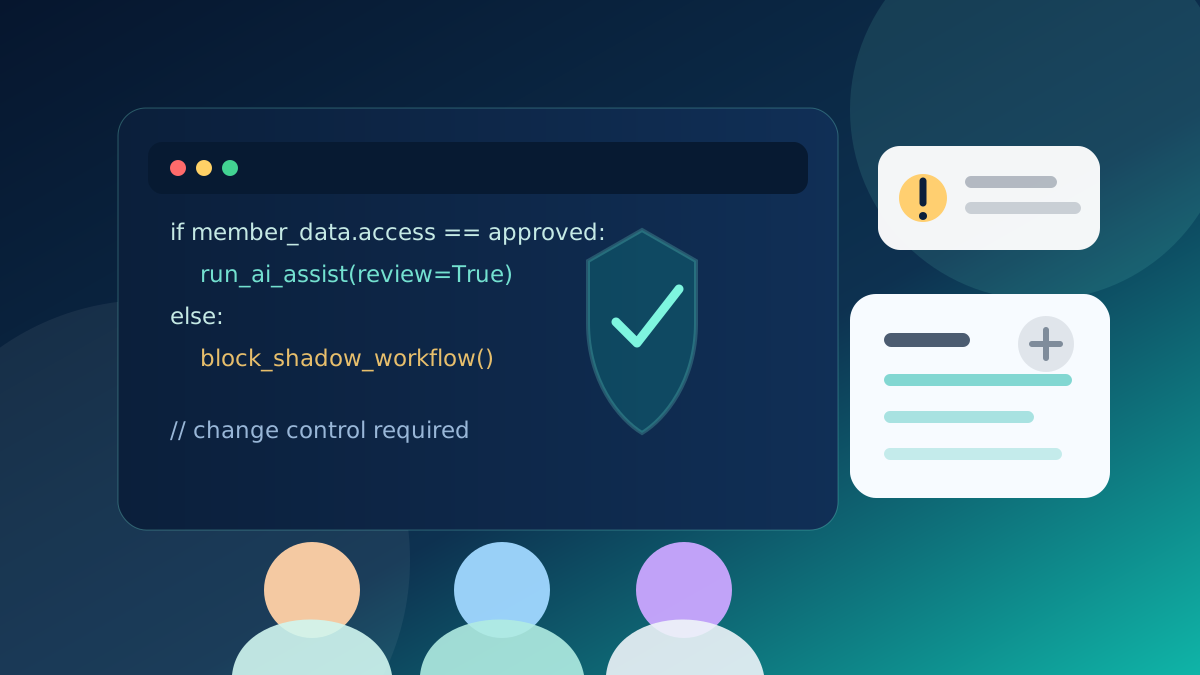
Credit unions do not need to ban AI-assisted development to manage the risk. A better first step is to classify use cases. Low-risk experiments using public or synthetic data can be encouraged. Anything touching member data, account workflows, lending, payments, fraud controls, compliance, or production systems should require approval, testing, and documentation.
That distinction lets teams learn without turning every experiment into an institutional risk.
The bottom line
Vibe coding is catchy because it captures a real shift: software creation is becoming easier, faster, and more widely distributed. For credit unions, that creates opportunity — but also a governance gap.
The institutions that handle this well will not be the ones that ignore AI coding or embrace it blindly. They will be the ones that make clear where experimentation ends and regulated technology begins.